
Overview
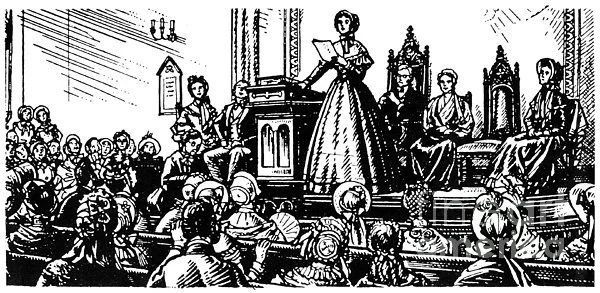
Seneca Falls, New York. July 11, 1848. Elizabeth Cady Stanton, Lucretia Mott, and local Quakers have announced their first-of-its-kind convention on women’s rights. The notice is picked up by newspapers, including Frederick Douglass’ North Star, spreading awareness about the event. The convention attracts widespread attention, bringing together reformers, abolitionists, and curious citizens who travel from nearby towns to participate in its discussions. Together, the participants will discuss the social, civil, and moral rights of women, in both the short and long-term. The Seneca Falls Convention will go on to inspire other women’s rights conventions across New England. This committee will largely follow General Assembly procedure to create a document outlining the conclusions of their deliberations.
Topic: Seneca Falls Convention, 1848
Today, with the benefit of hindsight, the path to women’s social, civil, and moral rights may seem clear. At the time, however, it was anything but straightforward. When initially proposing ideas such as women’s suffrage, every detail required careful thought, from determining which topics to include to deciding how demands should be presented. In this committee, delegates will deliberate over the best course of action, weighing differing perspectives and considering both immediate and long-term goals. They must decide which rights to prioritize, how strongly to press each point, and how to balance ambition with practicality. Equally important is how these ideas are framed, as they will be presented to a broader audience that may be skeptical or openly resistant. The committee must craft language that is firm yet persuasive, aiming to communicate their position clearly while anticipating criticism and opposition from both the public and established institutions.
Inclusivity Statement:
BosMUN recognizes that both conscious and subconscious gender-based discrimination, stereotypes, and biases often negatively affect the experiences of female, transgender, and non-binary delegates in Model UN. This committee is designed to minimize gender-based discrimination and create a safe space for female, transgender, and non-binary delegates by inviting only delegates who identify as female, transgender, or non-binary to compete in this committee.
BosMUN also recognizes that gender is a spectrum, that each person connects differently to their gender identity, and that gender expression and appearance do not necessarily reflect a person’s gender identity. Therefore, delegates will not be asked to verify their gender identity upon registration or arrival at the conference. BosMUN asks that all delegates register for the committee in good faith and that all delegates respect each others’ gender identity and expression.
BosMUN has a zero-tolerance policy for any and all forms of discrimination, including, but not limited to, discrimination based on race, color, gender, sexual orientation, national origin, religion, age or disability. Delegates must behave respectfully to all fellow delegates, conference staff, and BosMUN Secretariat members. Any violation of this policy will be addressed appropriately by the BosMUN Secretariat.